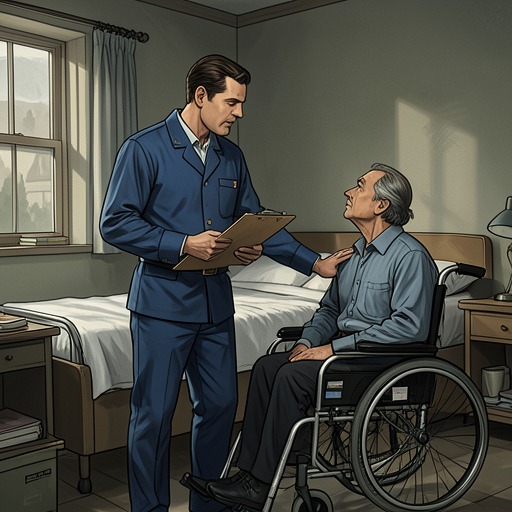
Claudette Albertson
Doctor SleepClaudette Albertson is a registered nurse at Rivington House, where her attentive, matter-of-fact work helps Dan Torrance respond to residents nearing death. In the account of Charlie Hayes’s final night, she supplies a crucial chronology of his condition and makes sure Dan is called; her part is practical rather than dramatic, but it helps him reach Charlie in time to offer comfort.
Identity and Work
Claudette is introduced as a cheerful African American nurse. She and Dan share a smoking break when he asks about Helen Rivington, the woman associated with the hospice. Claudette explains that Rivington left the town a substantial sum and gave it her house because she wanted older people to have a place where they could die with dignity. Her account connects the institution’s purpose to its benefactor’s intentions, and Dan’s work there to a form of care that attends to people at the end of life.
Claudette appears at work in the nurses’ station, charting medications alongside Janice Barker. The setting presents her as part of the ordinary routines that keep the hospice functioning: staff record care, check residents, and alert Dan when someone’s condition changes. Her contribution is not presented as a formal medical diagnosis. Instead, she observes, shares what she knows, and ensures the person responsible for responding is informed.
The Call About Charlie Hayes
On a stormy night, Claudette uses the intercom to tell Dan that there is a resident he should see. Dan initially thinks she means Vera Winnick, whose condition has been precarious, but Claudette clarifies that the resident is Charlie Hayes, on the first floor. When Dan asks who is the doctor on call, she tells him that he is; the physician, Emerson, cannot be reached in the severe weather. The exchange shows the practical limits on medical support that night and why Dan’s presence matters.
At the nurses’ station, Claudette gives Dan a detailed account of the preceding hours. Azzie had been meowing outside Charlie’s door when the staff began their shift at midnight, so Claudette let the cat in. Charlie was awake and responsive, greeted her, and petted Azzie, so she decided not to call Dan immediately. About an hour later, Charlie had a nosebleed. Fred Carling cleaned him, and Claudette instructed him to place the used towels in a dissolvable plastic bag for contaminated materials. When Janice checked Charlie later, he was asleep; after being roused, his eyes looked bloodshot. These details give Dan a sequence of observations rather than a diagnosis, helping him understand what had changed since the earlier checks.
Claudette’s decision to wait is tied to what she saw: Charlie was responsive when she first checked on him. She had considered calling Dan, and she does so when the subsequent signs warrant attention. Her account is candid about both the interval and the reason for it. That specificity allows Dan to assess the situation without suggesting that Claudette knew what would happen or could determine the cause of Charlie’s decline.
Care and Narrative Significance
Claudette’s role in Charlie’s final hours is part of a wider pattern of shared hospice care. She notices a change, communicates it, and supplies context; Dan then goes to the bedside. Charlie is ninety-one, extremely frail, and initially appears barely present, but he tells Dan that he is frightened by the possibility that death means nothing follows. Dan takes his hand, recognizes that Charlie has reached the border of death, and stays with him. Claudette does not take part in that intimate conversation, but her prompt and informative report helps bring Dan to the room where it can occur.
Her brief exchange with Dan also establishes the collegial directness of their working relationship. She calls him the doctor on call, while he distinguishes his hospice role from that of the physician who cannot get through the storm. Claudette neither obscures the staffing constraint nor embellishes her report. The story gives her significance through these small acts of communication: explaining the hospice’s founding purpose, monitoring a resident, handling a practical infection-control measure, and making sure Dan knows when a patient needs him.